“Weeks passed, and the little Rabbit grew very old and shabby, but the Boy loved him just as much.
He loved him so hard that he loved all his whiskers off,
and the pink lining to his ears turned grey, and his brown
spots faded. He even began to lose his shape,
and he scarcely looked like a rabbit any more,
except to the Boy. To him he was always beautiful,
and that was all that the little Rabbit cared about.
He didn't mind how he looked to other people,
because the nursery magic had made him Real,
and when you are Real shabbiness doesn't matter.”
The Velveteen Rabbit
is a children's novel written by Margery Williams
and illustrated byWilliam Nicholson.
It chronicles the story of a stuffed rabbit and his quest
to become real through the love of his owner.
The book was first published in 1922
and has been republished many times since.
29 mei 2014
~The Velveteen Rabbit
~Quote
“Life can be wildly tragic at times, and I've had my share.
But whatever happens to you, you have to keep
a slightly comic attitude.
In the final analysis, you have got
not to forget to laugh.”
by Katharine Hepburn
7 februari 2014
~Eileen Soper
Eileen Soper was born Enfield, Middlesex, 26 March 1905,
the daughter of an illustrator, George Soper.
Along with her elder sister Eva,
she attended Olive Downing’s School in Knebworth and Hitchin Girls’ School. At the time of her father’s death, in 1942,
she was worked primarily as an illustrator,
notably with the children's author, Enid Blyton.
Eileen illustrated the entire series of Famous Five adventures
and a vast range of other books.
In addition she authored and illustrated 23 books of her
own that displayed her growing talent for wildlife illustration.
She was a founder member of the Society of Wildlife
Artists in 1964 and was elected to the membership of the
Royal Society of Miniature Painters in 1972.
Then rather like a character from Marilynne Robinson's Housekeeping she let much of the rare flora planted by
her father return to a state of wildness and even allowed
the animals of the garden into the house.
She shared this singular location with only one other human,
her somewhat shadowy sister Eva.
Eileen died in 1990,
Eva outlived her by only six months. The estate and copyright of George and Eileen Soper are now in the care of the
Chris Beetles Gallery.
8 december 2013
~Poem for Christmas!
Clement Clarke Moore (1779 - 1863)
wrote the poem Twas the night before Christmas
also called “A Visit from St. Nicholas" in 1822.
It is now the tradition in many American families
to read the poem every Christmas Eve.
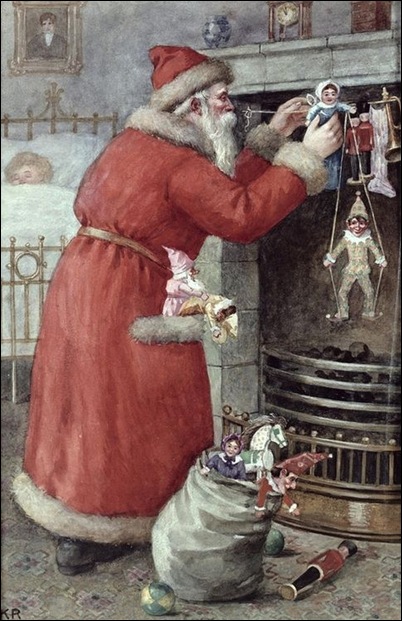
“Twas the night before Christmas, when all through the house
Not a creature was stirring, not even a mouse;
The stockings were hung by the chimney with care,
In hopes that St. Nicholas soon would be there;
The children were nestled all snug in their beds;
While visions of sugar-plums danced in their heads;
And mamma in her 'kerchief, and I in my cap,
Had just settled our brains for a long winter's nap,
When out on the lawn there arose such a clatter,
I sprang from my bed to see what was the matter.
Away to the window I flew like a flash,
Tore open the shutters and threw up the sash.
The moon on the breast of the new-fallen snow,
Gave a lustre of midday to objects below,
When what to my wondering eyes did appear,
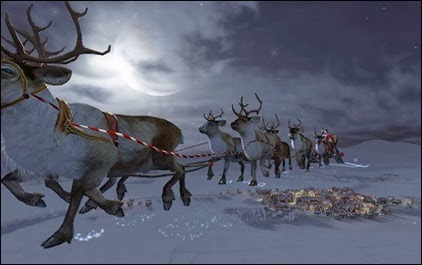
But a miniature sleigh and eight tiny rein-deer,
With a little old driver so lively and quick,
I knew in a moment he must be St. Nick.
More rapid than eagles his coursers they came,
And he whistled, and shouted, and called them by name:
"Now, Dasher! now, Dancer! now Prancer and Vixen!
On, Comet! on, Cupid! on, Donder and Blixen!
To the top of the porch! to the top of the wall!
Now dash away! dash away! dash away all!"
As leaves that before the wild hurricane fly,
When they meet with an obstacle, mount to the sky;
So up to the housetop the coursers they flew
With the sleigh full of toys, and St. Nicholas too—
And then, in a twinkling, I heard on the roof
The prancing and pawing of each little hoof.
As I drew in my head, and was turning around,
Down the chimney St. Nicholas came with a bound.
He was dressed all in fur, from his head to his foot,
And his clothes were all tarnished with ashes and soot;
A bundle of toys he had flung on his back,
And he looked like a pedler just opening his pack.
His eyes—how they twinkled! his dimples, how merry!
His cheeks were like roses, his nose like a cherry!
His droll little mouth was drawn up like a bow,
And the beard on his chin was as white as the snow;
The stump of a pipe he held tight in his teeth,
And the smoke, it encircled his head like a wreath;
He had a broad face and a little round belly
That shook when he laughed, like a bowl full of jelly.
He was chubby and plump, a right jolly old elf,
And I laughed when I saw him, in spite of myself;
A wink of his eye and a twist of his head
Soon gave me to know I had nothing to dread;
He spoke not a word, but went straight to his work,
And filled all the stockings; then turned with a jerk,
And laying his finger aside of his nose,
And giving a nod, up the chimney he rose;
He sprang to his sleigh, to his team gave a whistle,
And away they all flew like the down of a thistle.
But I heard him exclaim, ere he drove out of sight—
“Happy Christmas to all, and to all a good night!”
Poem by Clement Clarke Moore
http://www.carols.org.uk
Image~by svetoknz
31 oktober 2013
15 mei 2013
7 mei 2013
27 april 2013
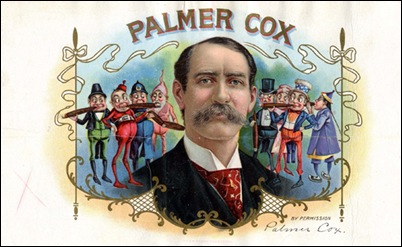
~Palmer Cox
Palmer Cox (April 28, 1840 – July 24, 1924)
was a Canadian illustrator and author,
best known
for the fictional creatures known as
the "Brownies his series of humorous verse
books and comic strips about the mischievous
but kindhearted fairy-like sprites.
The cartoons were published in several books,
such as The Brownies, Their Book (1887).
Palmer Cox is famous the world over for his
delightful children's books .
" His inspiration for the Brownies came from
the Scottish folklore that still survived in
and around Granby, Quebec, where he was born in 1840.
Cox learned these folktales from his mother which
featured the Brownies, or little members of the fairie
or goblin world: "imaginary sprites who delight in harmless pranks and helpful deeds. They work and sport
while weary households sleep, and never allow
themselves to be seen by mortal eyes.
~More to read~
8 april 2013
3 april 2013
29 maart 2013
15 maart 2013
"Each leaf,
each blade of grass
vies for attention.
Even weeds
carry tiny blossoms
to astonish us."
- Marianne Poloskey
I found this on Facebook
but no name of artist
but I had to share, this is soooo wonderful and amazing
don’t you think?
12 februari 2013
Oraciones en el sauce / Prayers on a weeping willow
by Diego Peñuela on Flickr
This illustration was part of "A song for Japan",
a beautiful project by PechaKucha Night Bogota,
done for the victims of Japan earthquake, 2011
7 februari 2013
17 januari 2013
13 januari 2013
11 januari 2013
9 januari 2013
8 januari 2013
~Vintage book
Magical illustrations by Else Wenz-Viëtor,
1882-1973
one of Germany's most well known
and prolific children's illustrators...
This wonderful book is my own dutch copy
I bought on flea market.
7 januari 2013
5 januari 2013
3 januari 2013
2 januari 2013
29 december 2012
24 december 2012
22 december 2012
20 december 2012
19 december 2012
Mireille Havet (1898, Médan, Yvelines - 1932)
was a French poet, diarist, novelist, and lyricist.
She wrote lyrics for songs composed by
John Alden Carpenter and intended for Éva Gauthier.
She wrote a novel, Carnaval, published in 1923.
She was friends with Jean Cocteau and Colette,
who referred to her as “la petite poyétesse”.
Her diary, which she kept from 1913 to 1929,
was only found again in 1995,
and published in 2003.
(source: Wikipedia)
18 december 2012
8 december 2012
To laugh often and much;
to win the respect of intelligent people and
the affection of children;
to earn the appreciation of honest critics
and to endure the betrayal of false friends.
To appreciate beauty;
to find the best in others;
to leave the world a bit better whether
by a healthy child,
a garden patch,
or a redeemed social condition;
to know that even one life has breathed easier
because you have lived.
This is to have succeeded.
— Ralph Waldo Emerson