
Peter Pan and Wendy illustrated by
Mabel Lucie Attwell, 1921
I Found these Illustration via 0rchid-thief.livejournal.
. 


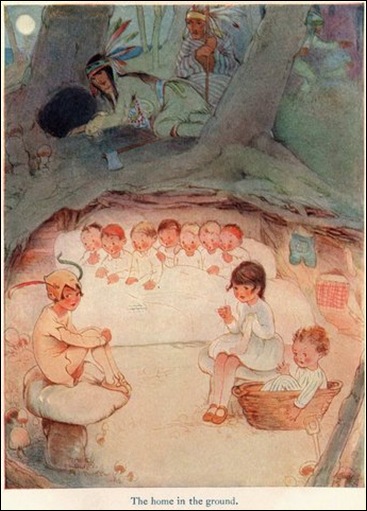


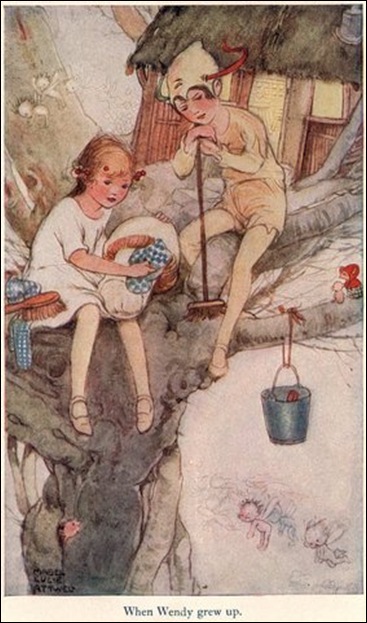
Peter Pan and Wendy illustrated by
Mabel Lucie Attwell, 1921
I Found these Illustration via 0rchid-thief.livejournal.
.

Charles Santore was born in born 1935
in Philadelphia. (VS)
He is an American illustrator best known for his
children's books. His work is on display permanently
at the Brandywine River Museum and the
Museum of Modern Art. He won the Hamilton King
award from the New York Society of Illustrators.
His book William the Curious won the 1998
Storytelling World Honor from Storytelling magazine.
.
Written by
Jacob Ludwig Carl Grimm and Wilhelm Grimm.
~ READ THE STORY HERE ~
.
Santore has also illustrated such classics as
The Wonderful Wizard of Oz (2000)
and Aesop’s Fables (1997).
Santore also writes and illustrates his own books.
His latest works are The Little Mermaid:
From the Story by Hans Christian Andersen (2009)
and The Life and Adventures of Santa Claus (2009),
an illustration of an L. Frank Baum tale.
. 


In the 1970s, he was one of the most prolific illustrators
of TV Guide covers. He is based in Philadelphia.
A branch library in South Philadelphia is named
Charles Santore Library after his father,
a political leader.
.
~ BOOKPAGE ~
. 

Born in 1949 Sam Skelton grew up in the
industrial town of Kirkintilloch. His father was a worker
at the local foundry and his memories of the scenes
around the foundry influenced his art work and fill his paintings.
Sam Skelton studied Graphic Design at the
Glasgow School of Art and worked as a graphic designer
before deciding to paint full time.
Sam Skelton’s paintings are nostalgic evocations
of Scotland’s industrial past: working class heroes,
boxers, a couple on a park bench, a group of men in
dark overcoats watching a game of football
played on waste ground.
The stark simplicity of Sam Skelton’s figures,
painted on rough Hessian, belie a rich heritage.
These are the kids playing on the street so familiar
from the paintings of Joan Eardley or the photographs
of Oscar Marzaroli. The influence of the great industrial
naïve painter, J.S. Lowry is clear. Skelton’s paintings are
suffused with the dark low light of Scotland in winter.
.


~ LINK ~
. 


Cliff Nielsen studied traditional and digital illustration and
graduated as valedictorian from Art Center College of Design
in 1994. His illustrations have been recognized for their
excellence by the Society of Illustrators, Print, and Spectrum.
Feature articles focusing on his work appear in design
publications and fanzine magazines alike.
Cliff has been an international speaker on digital art and
has served as a judge for the Society of Illustrators and
a variety of professional illustration award programs.
He lives in Los Angeles, California.
.


Nielsen who has illustrated the covers of
several children's books, including:
-Heir Apparent
-The Shadow Children series
-The Jedi Apprentice and The New Jedi Order series
-The Diane Duane books.
-The Bloody Jack Adventures.
-The Giver cover art.
.
Cliff Nielsen also illustrated the cover for the young adult
novel Blood and Chocolate by Annette Curtis Klause.
He illustrated the Marvel comic book Ruins.
.

~ LINK ~
. 

Give all to love;
Give all to love;
Obey thy heart;
Friends, kindred, days,
Estate, good-fame,
Plans, credit, and the Muse,--
Nothing refuse.
By Ralph Waldo Emerson (1803-1882)
Painting by Norman Precott Davies (1862-1915)

Italian illustrator Roberto Innocenti was born in 1940
and is known for his highly detailed, painterly style
and his devotion to realistic representation in such
classic works as Cinderella, The Adventures of Pinocchio,
A Christmas Carol, and Nutcracker.
He is also the illustrator of an original Holocaust tale,
Rose Blanche, that has been highly publicized throughout
Europe and the United States. Innocenti's illustrations
are unmistakable, demonstrating a delicacy of palette
as well as a refinement of line, both of which are surprising
in light of the fact that Innocenti is completely
self-trained in art.
.

Born in a small town near Florence, Italy, just after
the outbreak of World War II, Innocenti left school at
age thirteen to help support his family by working in
a steel foundry. By age eighteen he had moved to
Rome and found work in an animation studio,
a move that would influence his future career.
He began to learn the trade of illustration and soon
moved back to Florence. There he illustrated posters
for movies and the theater in addition to designing
books. In 1970 Innocenti met American artist John Alcorn,
who convinced him to try his hand at book illustration.
. 


Innocenti's early work for a North American audience
appeared in Golden Books with text by Seymour Reit.
The "All Kinds" series looks at transport from three
perspectives: planes, ships, and trains.
Each picture book gives a short history of the vehicle
in question, accompanied by pictures of a variety of types.
All Kinds of Ships, for example, introduces children to
the history of sailing, from the early boats hollowed out
of logs to the large supertankers that sail on the water today.
.
.
One of Innocenti's early major works was illustrating
the classic tale Cinderella by Charles Perrault.
Instead of setting the tale of rags to riches in some
remote fairy-tale kingdom, Innocenti decided to plant
it firmly in the twentieth century, locating Cinderella
in an English village during the Roaring Twenties.
He chose this time and place so that he would not
be influenced by all the illustrations of the story that
had come before, and also as he has explained, in order
to make Cinderella live more as a universal archetype
not limited by her time. Patty Campbell noted in
the New York Times Book Review that Cinderella is
"a witty flapper era" rendition that "has been widely admired."
Cinderella was but the first of several classic tales
that Innocenti has illustrated, yet his next book would
be far from the realm of fairy tales.
.


Rose Blanche, coauthored by Innocenti and
Christophe Gallaz, is set in World War II, and draws on
illustrator Innocenti's childhood. It tells of the horrors
of that time as seen through the eyes of a young girl
who is not yet old enough to fully understand
the events surrounding her. Rose Blanche is a
young German girl who, witnessing a strange scene
in her village one day, is thrust face to face with the
reality of the Holocaust. The heroine's name is also
that of the youthful German resistance group which
tried to sabotage the Nazi war effort, often losing their
lives in the conflict. Rose Blanche, seeing the mayor of
her town handing over a small boy to the soldiers,
follows the tracks of the truck that has taken the boy away.
Deep in the woods she discovers a barbed-wire compound.
Inside are small children in striped uniforms bearing
a yellow star. Rose Blanche feels sympathy for these
children and brings them scraps of food she steals,
only to be shot by a soldier just as the war is ending.
She, like the resistance group of the same name,
has given her life for principle, becoming "a symbol
of goodness in a dark world," according to
Quill and Quire reviewer Susan Perren.
. 


